


U.S. Individual taxpayer: file your tax return now if you were supposed to file by April 18th, 2023, but missed that filing deadline.
You should file your 2022 tax return as soon as possible if you were required to file by the April 18th, 2023, deadline but weren’t able to. You are required to file a tax return if you are single under 65 and your gross income was at least $12,950. The following is a summary of situation where you’d be required to file as a w-2 employee:
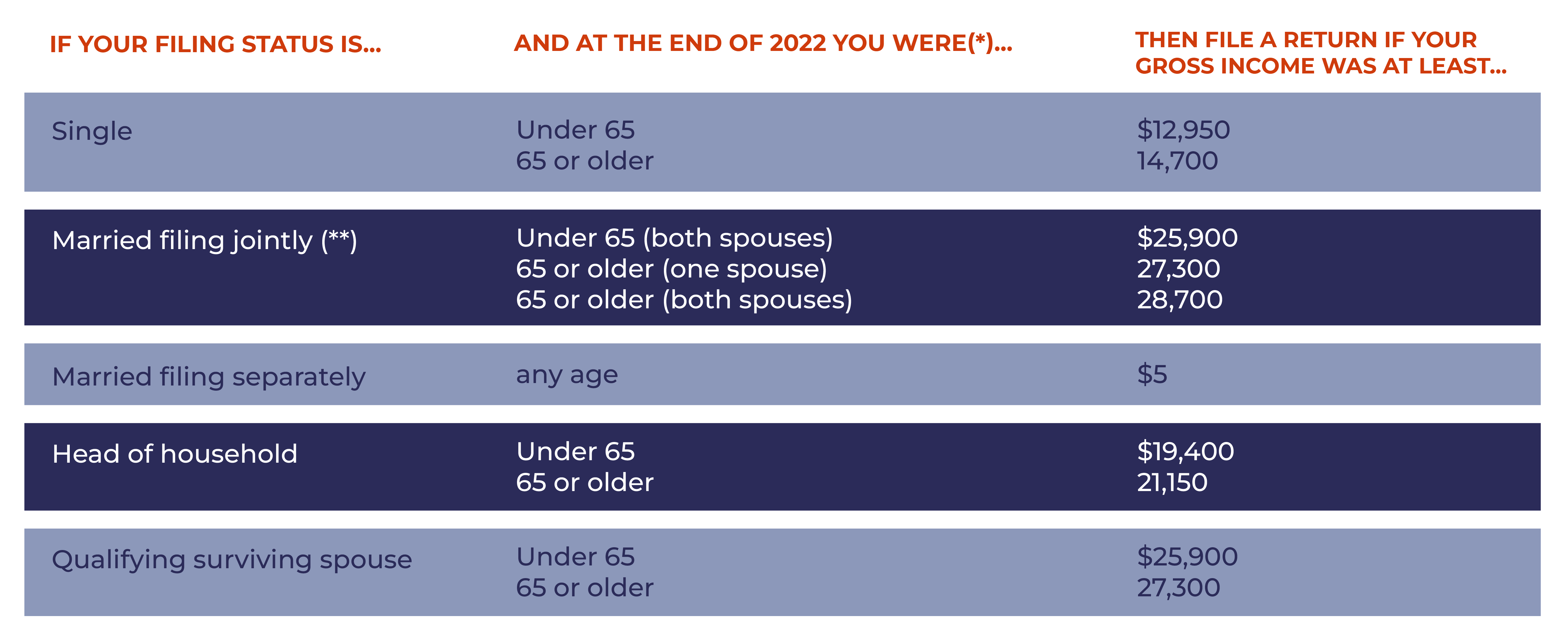
*If you were born on January 1, 1958, you are considered to be age 65 at the end of 2022. (If your spouse died in 2022 or if you are preparing a return for someone who died in 2022, see Pub. 501.)
**If you didn’t live with your spouse at the end of 2022 (or on the date your spouse died) and your gross income was at least $5, you must file a return regardless of your age.
If you’re self-employed, you’re required to file a tax return if your self-employment income after deduction of your expenses is $400 or more.
If you owe tax and are unable to pay your tax bill by the deadline, you should nevertheless take any of the following steps to limit the amount of penalties and interest:
File your tax return or request an extension of time to file by the deadline.
Pay as much as possible by the April due date.
Review the following options that the IRS offers to help taxpayers pay their tax bill:
- Payment plans: you can apply for a payment plan on IRS.gov or in writing using Form 9465, Installment Agreement Request.
- Offer in Compromise — An Offer in Compromise lets you settle your tax debt for less than the full amount if you can’t pay your full tax liability or doing so creates a financial hardship. You can see whether you’re eligible and prepare a preliminary proposal with the Offer in Compromise Pre-Qualifier Tool.
- Penalty relief — You may qualify for penalty relief if you tried to comply with tax laws but were unable due to circumstances beyond your control.
This is because, you may qualify for penalty relief under the following circumstances:
- You have filed your individual income tax return and paid any balance due timely for the past three years before the tax year you received the penalty;
- You didn’t receive any penalties during the last 3 years, or any penalty was removed for an acceptable reason other than First Time Abate;
- You filed all required returns or filed a valid extension of time to file; and
- You paid or have arranged to pay all taxes due for years other than the one you’re requesting relief for.

If you don’t owe tax
Even if you don’t earn enough to meet the filing requirement, you should consider filing to receive a refund due to potential refundable credits for which you may be eligible. This includes the Earned Income Tax Credit (EITC) and the Child Tax Credit (CTC).
Example: you’re a U.S. resident alien who worked as a w-2 employee and earned a salary during the year. Your brokerage account statement reflects $500 of investment income. You claim your daughter on your tax return. You may get a refundable earned income tax credit (EITC).
There is no penalty for filing your tax return after the April 18th initial due date if a refund is due. We recommend you use the electronic filing options that the IRS makes available to you. Learn more.
You may have more time beyond the April 18th tax deadline to file and pay your taxes if you live in a FEMA declared disaster area, live overseas or are in the military in combat zones:
> If you live in a storm-damaged area of California, you have until October 16, 2023.
> If you’re a member of the military who served or are currently serving in a combat zone, you may qualify for an additional extension of at least 180 days.
> If you’re a support personnel in combat zones or a contingency operation in support of the Armed Forces, you also qualify for an additional extension of at least 180 days.
> If you’re a U.S. citizen or resident alien who lives and works outside of the United States and Puerto Rico or a military member on duty who doesn’t qualify for the combat zone extension, you may qualify for an additional two months.