


Individual taxpayer: here are a few things that you should know about standard and itemized deductions.
To reduce your tax bill, you should generally choose the larger of itemized deduction or standard deduction.
Let’s go over together these nuances that can be very helpful.
STANDARD DEDUCTION
Definition and legal framework
The standard deduction is a lump sum that you can deduct from your taxable income to arrive at the revenue that you should pay tax on. The Government assumes that you paid this expense to make the money that you’re reporting. This is true even if you didn’t spend that amount.
The amount of standard deduction that you can take depends on your filing status. For your 2022 revenue taxed in 2023, depending on your filing status you can take the following standard deduction:
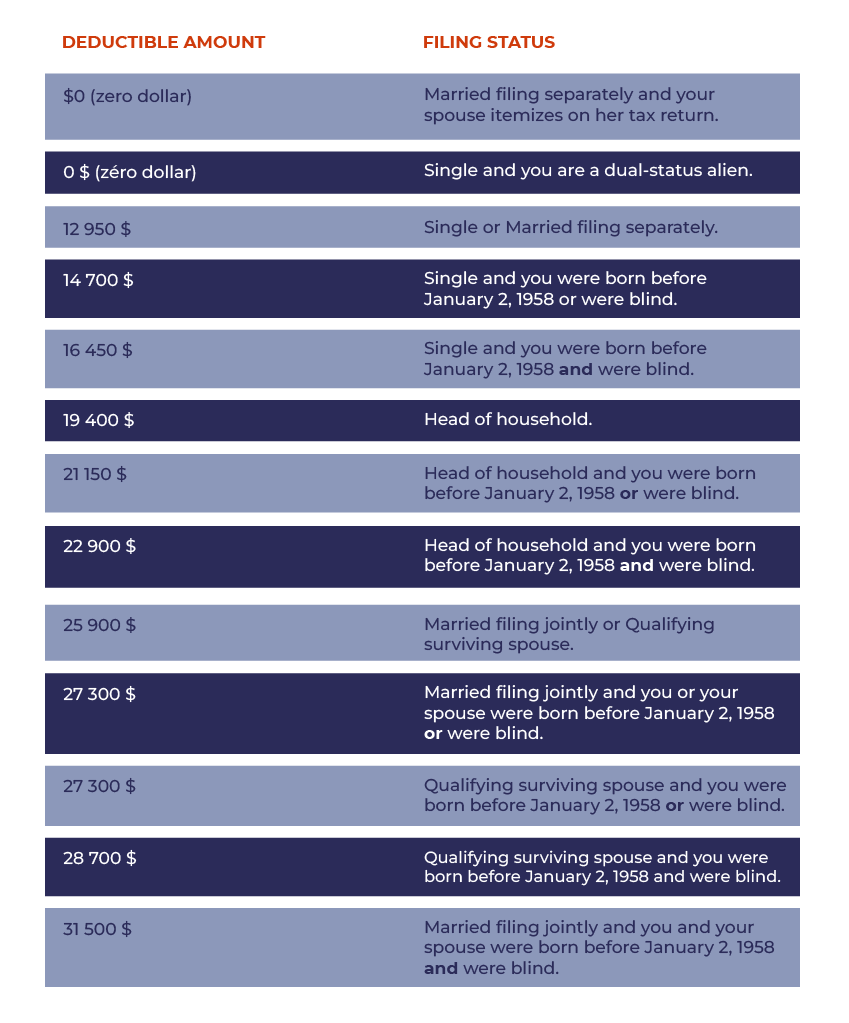
Example: you’re married and file your tax return jointly with your spouse. You and your spouse were born after January 2, 1958. You are not blind, and your parents are not claiming you as dependents. In that case, in 2022, your standard deduction is $25,900.
Use of the standard deduction worksheet for dependents to figure your standard deduction.
If someone reports your (or your spouse’s) name and social security number in the Dependents section of their tax return, you must use the Standard Deduction Worksheet for Dependents to figure your standard deduction.
Net qualified disaster loss
If you suffer personal casualty loss in 2022, you may choose to increase your standard deduction by the amount of your net qualified disaster loss.
Example: a hurricane hit your state and made your home unsafe to live in. The area is declared a disaster area. Two months later, your state or local government ordered you to tear it down or move it.
ITEMIZED DEDUCTION
The itemized deduction refers to a list of expenses that you actually paid and are allowed to write off.
If you have more expenses than the amount of standard deduction that you can take, you may choose to itemize deductions. You do so by reporting the expenses that you paid for on Schedule A, Form 1040 Itemized Deductions. You may claim expenses such as:
- Your unreimbursed medical and dental expenses that exceed 7.5% of your adjusted gross income.
- The state and local income tax or sales tax that you paid.
- The real estate and personal property taxes that you paid.
- Your home mortgage interest.
- Gifts to IRS approved charitable organizations.
- Personal casualty and theft losses from a federally declared disaster.
Example: in 2022 you paid mortgage interest for a mortgage on your home and property tax. You also donated cash amount to the local church and paid medical expenses. Your health insurance provider reimburses only 25% of your medical expenses. You may itemize deduct the mortgage interest, the property tax and the portion of the medical expenses that haven’t been reimbursed.

Every year, hundreds of millions of individual taxpayers file a tax return with the Internal Revenue Service (IRS). Most of them file their tax return during the period January 1 – April 15, commonly referred to as tax season.